Chain Link Fence Installation in Monmouth County, NJ
Galvanized steel mesh and vinyl-coated chain link — installed with no deposit required — call for a free estimate.
Why Do Thin-Gauge Chain Link Fences Sag, Rust, and Fail Within a Few Years?
The problem starts with lightweight 11-gauge or 11.5-gauge wire. Budget chain link installers use thinner wire to cut material costs, but the resulting fence cannot maintain tension over time. Within two to three years, the mesh sags between posts, the top rail bows, and the fence loses its structural integrity. Wind, snow load, and even a large dog leaning against it accelerates the failure.
Cheap galvanization compounds the durability problem. Low-cost chain link fence fabric receives a thinner zinc coating during the galvanizing process. In Monmouth County's coastal environment, where salt air is a constant factor, thin galvanization breaks down faster than manufacturer warranties suggest. Rust spots appear within a few seasons, and once corrosion starts it spreads rapidly along each wire intersection.
We solve both problems by installing 9-gauge galvanized steel mesh as standard. Heavier wire holds tension permanently, resists impact and climbing, and accepts a thicker zinc coating that stands up to coastal conditions. Combined with properly spaced line posts set in concrete and commercial-grade tension bars, the result is a chain link fence that stays taut and corrosion-free for 20 to 30 years.
If your current chain link fence is sagging or rusting, replacement costs less than you expect. Call (732) 400-5426 for a free estimate. We remove the old fence and install the new one in the same visit — call for a free estimate all-inclusive.
What Makes 9-Gauge Galvanized Steel Mesh the Right Choice for Monmouth County Properties?
9-gauge wire is 37% thicker than 11-gauge wire, which translates directly to strength and longevity. Each strand of 9-gauge galvanized steel mesh measures 0.148 inches in diameter compared to 0.120 inches for 11-gauge. That difference means the fence holds tension more effectively, resists denting from impact, and carries a thicker zinc coating that protects against Monmouth County's salt-air corrosion.
Galvanized steel mesh with knuckle-twist selvage at top and bottom creates a smooth, safe edge. Knuckle-twist selvage folds each wire end into a rounded loop rather than leaving a sharp barb. This is the standard we install for residential properties, playgrounds, and pet enclosures where safety matters. Barbed selvage is available for commercial and security applications where deterrence is the priority.
Standard Galvanized Chain Link
Classic silver galvanized chain link is the most economical fencing option available. The zinc-coated steel resists corrosion, requires zero maintenance, and provides clear boundary definition and pet containment. Available in 3-foot, 4-foot, 5-foot, and 6-foot heights through our Eastern Chain Link dealership.
Galvanized chain link works well for backyards, side yards, and property lines. The open mesh design maintains sight lines and airflow while keeping children and pets safely contained. For added privacy, we can install privacy slats — vertical inserts that weave through the mesh to block visibility.
Vinyl-Coated Chain Link
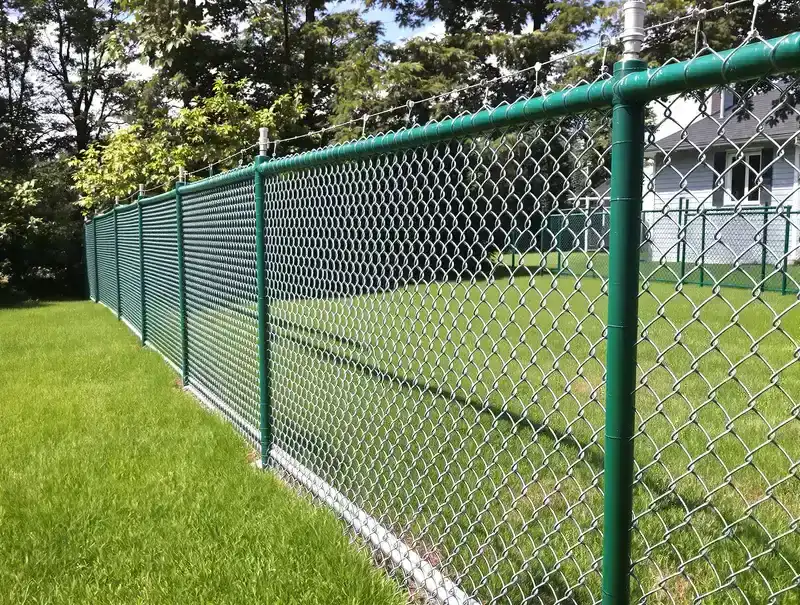
Vinyl-coated chain link wraps each galvanized wire in a colored PVC layer. Black is the most popular color because it virtually disappears against dark backgrounds like tree lines and hedges. Green blends with lawns and shrubs. Brown works well against wooden structures and natural landscapes.
The vinyl coating adds 10 or more years to the fence's lifespan. PVC creates a waterproof barrier over the galvanized core, preventing moisture from reaching the steel even if the zinc layer wears thin. Vinyl-coated chain link also feels smoother to the touch and eliminates the metallic look that some homeowners find industrial.
Terminal Posts, Line Posts, and Tension Bar Assembly
Every chain link fence relies on a framework of terminal posts and line posts. Terminal posts — which include end posts, corner posts, and gate posts — are the structural anchors of the system. They are heavier gauge steel than line posts and receive the tension bars and bands that pull the mesh taut. Line posts support the fabric between terminal posts and are spaced 10 feet apart for standard installations.
Tension bars run vertically through the mesh at each terminal post. The tension bar connects to tension bands bolted around the terminal post, creating the mechanical force that keeps the chain link fabric stretched tight. Without proper tension bar installation, the mesh loosens over time and sags away from the framework. We install commercial-grade tension hardware on every residential fence.
Top Rail and Framework Options
The top rail connects all posts along the fence line and supports the upper edge of the mesh. We use 1-3/8-inch diameter galvanized steel top rail for residential fences and 1-5/8-inch for commercial-grade installations. The top rail slides through loop caps on each line post and connects to brace bands on terminal posts, creating a rigid upper framework that prevents the mesh from folding over.
Line post spacing directly affects the fence's resistance to wind and impact. Standard 10-foot spacing works well for most residential applications. For taller fences, exposed locations, or properties near the Monmouth County coastline where wind loads are higher, we tighten the spacing to 8 feet for additional rigidity. Browse chain link fence designs in our catalog to compare options and configurations.
Gates, Hardware, and Access Points
Chain link gates are built with the same gauge framework as the fence fabric. Walk gates, double-swing gates, and rolling cantilever gates are available for residential and commercial applications. Each gate includes a fork latch, hinges, and optional padlock capability. Self-closing hinges and magnetic latches are available for pool enclosures that must meet NJ barrier code.
Gate posts are set deeper and in larger concrete footings than line posts. The repeated stress of opening and closing a gate puts additional lateral force on the post, so we set gate posts at 36 inches minimum depth with an oversized footing. This prevents the common problem of gate posts leaning inward and causing the gate to drag or bind. If you're considering other material options alongside chain link, aluminum fences offer a similar open-view design with a more decorative profile.
How Does a Chain Link Fence Installation Go from Estimate to Completion?
Three simple steps cover the entire process. We handle material sourcing, permits, and labor — you choose the height, color, and gate locations.
On-Site Measurement
We visit your property, measure the fence line, and discuss your needs. You'll receive a written all-inclusive quote covering galvanized or vinyl-coated chain link in your chosen height. Call for a free estimate — no hidden fees and no deposit.
Material Prep and Permitting
We order materials from our Eastern Chain Link supply line and pull any required permits. You'll receive a confirmed installation date. Most residential chain link projects complete in a single day for properties under 200 linear feet.
Same-Day Installation
Posts are set in concrete, the top rail is assembled, and the mesh is stretched tight with tension bars. We install all gates, hardware, and caps. All debris is removed and your yard is left clean. You pay only when the fence is complete and you're satisfied.
What Are the Practical Benefits of Choosing Chain Link Over Other Fence Types?
Chain link delivers unmatched value when the priority is durability, low maintenance, and cost efficiency. Here are five reasons it remains one of the most installed fence types in Monmouth County.
Lowest Cost Per Foot
Chain link is the most affordable fence material per linear foot. For homeowners who need to enclose a large area — a full backyard, a multi-acre lot, or a recreational field — chain link delivers the most linear footage per dollar of any fence type.
Zero Maintenance Required
Galvanized steel mesh never needs painting, staining, or sealing. Unlike wood fences that demand periodic treatment or vinyl fences that need cleaning, chain link simply stands and performs for decades without any scheduled maintenance.
20 to 30 Year Lifespan
Galvanized chain link lasts two to three decades; vinyl-coated lasts even longer. The combination of 9-gauge wire, heavy zinc coating, and corrosion-resistant framework creates a fence system that outlasts most other residential fencing options at a fraction of the cost.
Handles Any Terrain
Flexible mesh follows slopes, hills, and uneven ground naturally. Chain link is one of the few fence types that can be installed on steep grades without custom engineering. The mesh conforms to the terrain while the framework follows the slope.
Secure Pet Containment
9-gauge chain link resists digging, climbing, and chewing by dogs. The continuous mesh has no gaps for small animals to squeeze through, and the steel construction cannot be damaged by claws or teeth. Add a bottom tension wire to prevent dogs from pushing under the fabric.
Fast Installation
Most residential chain link projects complete in a single day. The modular framework system — terminal posts, line posts, top rail, and rolled mesh — goes together efficiently. Faster installation means less disruption to your property and schedule.
Ready to Price a Chain Link Fence for Your Property?
Free on-site estimates for every Monmouth County homeowner. No deposit, no pressure, no obligation. Galvanized or vinyl-coated — we'll help you choose the right option for your property and budget.
Common Questions About Chain Link Fence Installation in New Jersey
-
9-gauge wire is the strongest standard option for residential chain link fences. The lower the gauge number, the thicker the wire. 9-gauge wire resists bending, climbing, and impact far better than the 11 or 11.5 gauge wire used in budget installations. We install 9-gauge galvanized steel mesh as standard because it delivers decades of service without sagging or stretching.
-
Galvanized steel mesh lasts 20 to 30 years in Monmouth County's climate. The zinc coating protects the steel core from rust and corrosion. Vinyl-coated chain link lasts even longer — 30 to 40 years — because the PVC coating adds a second layer of protection over the galvanized core. Both options far outlast wood fencing with minimal maintenance.
-
Galvanized chain link is bare zinc-coated steel with the classic silver appearance. Vinyl-coated chain link wraps each wire in a layer of colored PVC — typically black, green, or brown — that blends with landscaping and adds corrosion resistance. Vinyl coating costs slightly more but dramatically improves the fence's appearance and extends its lifespan.
-
Terminal posts are placed at every change in direction, gate opening, and fence termination point. Line posts are spaced 10 feet apart between terminal posts. Closer line post spacing of 8 feet is used for taller fences or areas with high wind exposure. All posts are set in concrete footings at a minimum depth of 30 inches.
-
Yes, chain link is one of the easiest fence types to install on sloped terrain. The flexible mesh follows grade changes naturally without special racking hardware. On gentle slopes, the mesh follows the ground contour. On steeper grades, we step the fence in level sections between posts. Either method maintains a secure enclosure without gaps at the bottom.
-
Chain link fences require virtually zero maintenance. There is no staining, painting, or sealing needed. Occasionally check that tension bars and ties are secure, and trim vegetation away from the fence line to prevent vine damage. If a section is damaged, individual panels can be patched or replaced without disturbing the rest of the fence.
Get Your Free Chain Link Fence Estimate Today
Monmouth County homeowners have trusted us since 2010. Licensed, insured, and rated 4.7 stars on Google with 27 reviews. No deposit required. We also install aluminum fences if you want a more decorative open-view option. Call us or request your free estimate online.