Pool Fence Installation in Monmouth County, NJ
NJ BOCA pool code-compliant fencing with self-closing gates, self-latching hardware, and non-climbable design — free estimates.
Pool fence installation puts a code-compliant safety barrier around a residential pool. In Monmouth County, Fencing By Excellence builds pool fences to the NJ BOCA pool code — a 54-inch minimum height, non-climbable design, self-closing gate mechanism, and self-latching hardware — engineered to pass the township pool barrier inspection on the first visit.
Why an Improperly Fenced Pool Is the Most Dangerous Hazard on a Monmouth County Property
Drowning is the leading cause of accidental death for children ages one to four. A residential pool without a code-compliant barrier puts children, pets, and uninvited visitors at direct risk. The NJ BOCA pool code exists specifically because an unfenced or improperly fenced pool has caused preventable tragedies in communities throughout New Jersey.
Many existing pool fences fail inspection because they were installed before current codes. Older fences may lack the 54-inch minimum height, use climbable horizontal rails, or have gates that do not self-close and self-latch. Township inspectors in Monmouth County flag these deficiencies, and homeowners face fines, mandatory upgrades, or pool closure orders until the barrier meets code.
A code-compliant pool fence with a non-climbable design, self-closing gate mechanism, and self-latching hardware eliminates both the safety risk and the legal risk. It passes the pool barrier inspection on the first visit, satisfies your homeowner's insurance requirements, and creates a physical barrier that prevents unsupervised pool access by children and animals.
We install code-compliant pool fencing — see our pool fence installation pricing. Call (732) 400-5426 and we will visit your property, verify your township's specific pool barrier inspection requirements, and provide an all-inclusive price that covers every code-compliance element.
What does the NJ BOCA pool code require for a pool fence?
Minimum Height and Barrier Continuity Requirements
NJ pool barrier code requires a minimum 48-inch fence height — measured from the finished grade on the outside of the fence to the top of the fence. Municipalities that have adopted the 2015 or later IBC pool barrier code (most of Monmouth County) require 60-inch (5-foot) height when the fence is the sole barrier between the pool and the house. The barrier must be continuous — no gap greater than 4 inches at grade, no horizontal rails or protrusions that create footholds below 45 inches.
Gate Specifications — Self-Closing, Self-Latching, and Outward-Opening
Every gate in a pool barrier fence must be self-closing and self-latching. The latch mechanism must be located on the pool side of the gate at least 54 inches from the bottom of the gate — or, if located on the exterior side, must require simultaneous hand operations to open (to prevent young children from manipulating it). Gates must be outward-opening (swinging away from the pool) and must return to the closed and latched position without assistance from any starting position.
Prohibited Designs — What Makes a Pool Fence Non-Compliant
Several fence designs that are common in residential settings are code-prohibited as pool barriers. Chain link fence is technically permitted under code but the diamond aperture must be small enough to prevent footholds — most standard residential chain link does not meet this requirement. Horizontal rail designs that create a ladder-like surface below 45 inches are prohibited. Lattice-top extensions on 4-foot fence panels are prohibited if the lattice provides footholds. Any fence with openings greater than 4 inches (measured in the smallest dimension) is non-compliant.
Non-climbable design means no horizontal rails, mesh footholds, or exterior projections. The exterior face of the fence — the side facing away from the pool — must present a smooth, vertical surface with no features a child could use to climb. Vertical pickets spaced no more than four inches apart are the standard non-climbable configuration. Chain link is only permitted if the mesh openings are too small for a toe-hold, which effectively limits it to vinyl-coated mini-mesh designs.
Self-closing gate mechanisms automatically return the gate to the closed position. NJ code requires every pool gate to close on its own after someone passes through. We install spring-loaded hinges or hydraulic gate closers calibrated to close the gate firmly without slamming. The closer must work reliably in all weather conditions — freezing temperatures, salt air, and summer heat — which is why we specify marine-grade hardware rated for coastal NJ environments.
Self-latching hardware locks the gate automatically when it closes. The latch must engage without any manual action from the person passing through. NJ code requires the latch mechanism to be positioned on the pool side of the gate and at least 54 inches above grade so children cannot reach it from the exterior. We install magna-latch and key-lockable latches depending on the homeowner's preference and the township's inspection checklist.
No gap wider than four inches is allowed anywhere in the barrier. The space between pickets, under the bottom rail, and between the gate and gate post must all measure four inches or less. This gap standard prevents a child's body from passing through any opening in the fence. We check every panel, gate, and ground-clearance measurement during our post-installation walkthrough to ensure zero gaps exceed the four-inch maximum.
Aluminum pool fencing is the most popular material for pool barriers in Monmouth County. Aluminum does not rust, requires no painting, and is manufactured in pool-code-specific configurations with vertical pickets and no horizontal climbable elements. Pool-grade aluminum panels from Eastern Ornamental are factory-built to the 54-inch minimum height and come with pre-drilled mounting holes for self-closing hinges and self-latching hardware.
Vinyl pool fencing provides an alternative for homeowners who want privacy around the pool area. Solid vinyl panels block sightlines from neighbors while meeting the 54-inch height requirement. Vinyl is non-climbable by nature because the smooth surface offers no grip. Gates are fitted with self-closing and self-latching mechanisms identical to those used on aluminum pool gates.
Mesh pool fence panels offer a removable option for seasonal pools. The mesh material is non-climbable, meets the 54-inch height requirement, and uses tension poles secured in deck-mounted sleeves. Mesh pool fence panels can be removed and stored during the off-season, which appeals to homeowners who want an unobstructed view of the pool area when it is not in use. However, permanent fencing is required if the pool is accessible year-round.
For the complete breakdown of every NJ BOCA requirement, measurement standard, and gate specification, read our complete guide to NJ pool fence code requirements — or see a recent aluminum pool fence installation in our gallery.
Which pool fence materials pass NJ code most reliably?
Powder-coated aluminum with 3.5-inch or smaller picket spacing is the most reliable pool code pass. The non-climbable vertical picket design, no horizontal rails below 45 inches, and manufactured self-closing gate hardware are all designed around code compliance. A correctly specified aluminum pool fence passes first-inspection the vast majority of the time.
Vinyl pool fence is code-compliant when correctly specified — the panel must be solid (no lattice, no decorative cutouts) and the gate hardware must be pool-grade self-latching. Standard vinyl privacy fence panels with small gaps at the bottom or decorative routing can create compliance issues. We specify pool-grade hardware and solid panels as the default for all vinyl pool installations.
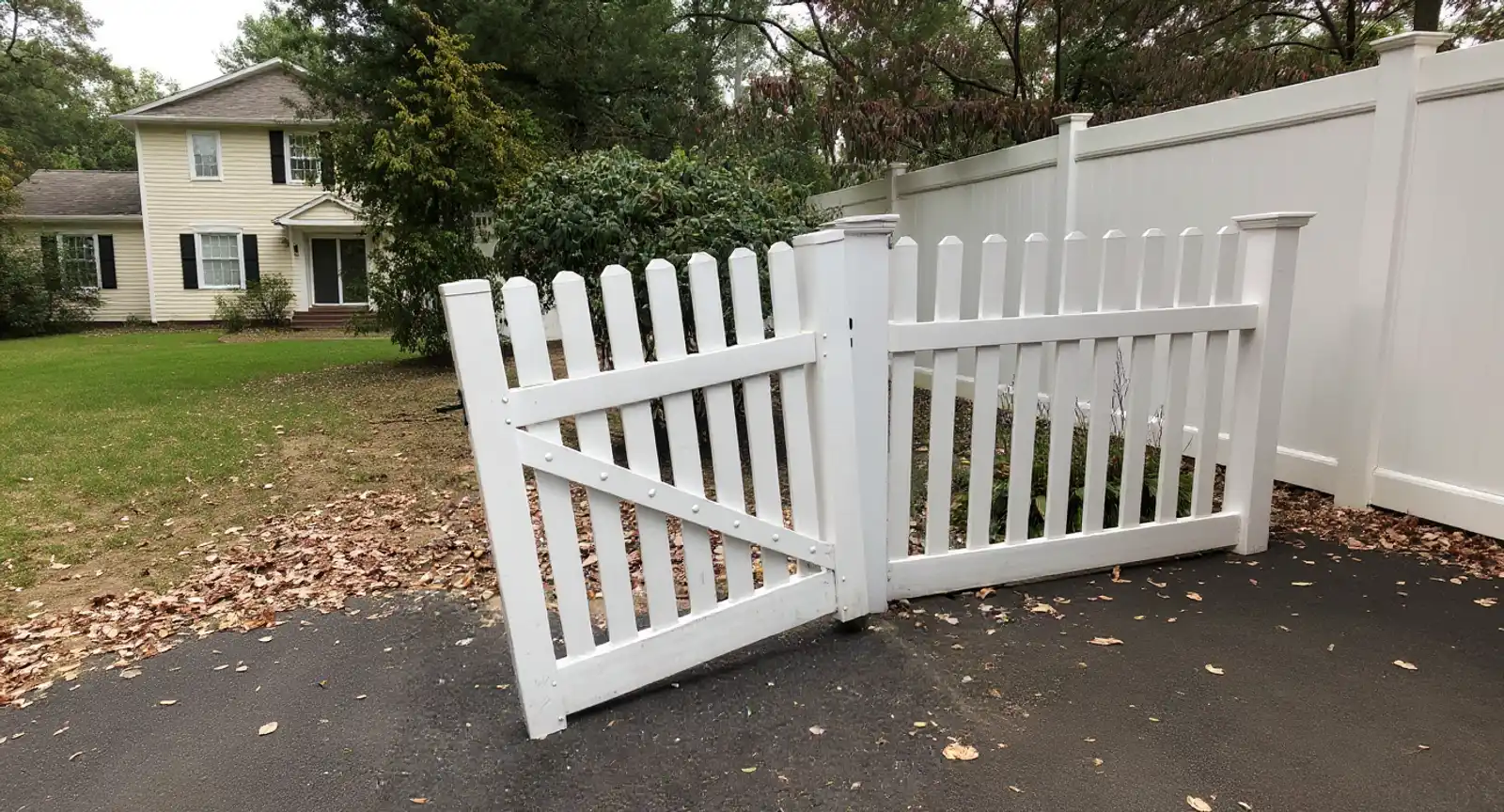
Wood pool fence requires the most careful specification. Wood picket spacing must be checked against the 4-inch rule. Horizontal rails on the pool side of the fence create climbable surfaces. Dog-ear pickets with their pointed tops technically add height but the code measurement is to the lowest point of the picket top, not the tip. We design all wood pool fences to pass inspection before the first board goes in.
Code-Compliant Pool Fence Installation in Three Steps
We verify your township's pool barrier inspection criteria before installation begins and build the fence to pass on the first inspection visit. Here is the process from your perspective.
Code Review & Estimate
We visit your property and review your township's specific pool barrier requirements. You choose between aluminum, vinyl, and mesh pool fence options. We provide an all-inclusive price covering all code-compliance elements.
Material Sourcing & Scheduling
We order pool-code-specific panels, self-closing hinges, and self-latching hardware from Eastern Ornamental or Illusions Fence. Utility mark-outs run concurrently. Note: permit applications are the homeowner's responsibility — we'll advise on what's required and which office to contact so the project stays on schedule.
Installation & Inspection Prep
We install posts, panels, gates, and all hardware to NJ BOCA pool code specifications. After cleanup, we verify every measurement — height, gap spacing, gate closure, latch position — so the fence is inspection-ready. You pay only after approval.
Real-World Benefits of a Non-Climbable Pool Fence with Self-Closing Gates
A code-compliant pool fence protects lives, satisfies inspectors, and reduces liability. Here are the specific benefits homeowners gain from proper pool barrier installation.
Child Drowning Prevention
A 54-inch non-climbable barrier with self-closing, self-latching gates prevents unsupervised pool access by children — the single most effective drowning prevention measure available.
First-Visit Inspection Pass
We build to your township's specific pool barrier inspection checklist, not just the minimum NJ BOCA pool code. The fence passes inspection the first time the inspector visits.
Insurance Compliance
Most homeowner's insurance policies require a code-compliant pool barrier. A properly installed pool fence satisfies that requirement and prevents coverage disputes if an incident occurs.
Reduced Liability Exposure
An attractive nuisance like a pool creates legal liability for the property owner. A code-compliant barrier demonstrates due diligence and significantly reduces exposure to negligence claims.
Pet Containment
Pool fencing keeps dogs and cats away from the water when unsupervised. Self-latching gates prevent pets from nosing the gate open and accessing the pool deck.
Property Value Protection
A code-compliant pool fence is a requirement for selling a home with a pool in NJ. Having it already installed avoids last-minute remediation costs during the sale process.
How much does a code-compliant pool fence cost in Monmouth County?
Pool fence installation starts at $31 per linear foot all-inclusive, with all NJ BOCA code compliance and self-closing gate hardware included. Pool-grade aluminum requires specific post-setting depths (deeper than standard residential) and self-latching gate mechanisms — both included in our all-inclusive price. The non-climbable picket spacing requirement (4-inch maximum) eliminates some panel styles, which can affect material options and cost. Properties with irregular pool shapes or existing hardscape (concrete decking, landscape borders) require more careful measurement — we account for all of it in the free estimate. Most in-ground pool fence projects clear the $5,000 threshold for the automatic 10% discount.
What's always included: Every pool fence project includes labor, materials, post-setting, and cleanup — no hidden fees, no surprises at the end. Our our all-inclusive pool fence pricing starts at $31 per linear foot. Jobs over $5,000 qualify for our 10% discount automatically.
Free estimate: We'll measure your property, walk through material options, and give you an exact price before any work begins.
Need a Pool Fence That Passes Inspection the First Time?
We verify your township's pool barrier requirements before installation and build to pass on the first visit. No obligation. Call now or request a free estimate online. Jobs over $5,000 receive 10% off.
Frequently Asked Questions About Pool Fences in New Jersey
- The NJ BOCA pool code requires a pool barrier with a minimum height of 54 inches, a non-climbable design with no horizontal rails or footholds on the exterior, self-closing gate mechanisms that return the gate to the closed position automatically, and self-latching hardware positioned at least 54 inches above grade on the pool side. The barrier must fully enclose the pool with no gaps larger than 4 inches that a child could pass through.
- A non-climbable design prevents children from scaling the fence to reach the pool unsupervised. The NJ BOCA pool code prohibits horizontal rails, chain link mesh below 54 inches, and any exterior feature that could serve as a handhold or foothold. Non-climbable pool fences use vertical pickets spaced no more than 4 inches apart with smooth surfaces that offer no grip. This design requirement exists because drowning is the leading cause of accidental death for children ages 1 to 4.
- A self-closing gate mechanism uses a spring hinge or hydraulic closer to pull the gate shut automatically after someone passes through. Self-latching hardware engages the latch automatically when the gate closes, without requiring manual action. Together, they ensure the pool gate is never accidentally left open. NJ code requires the latch to be on the pool side of the gate and at least 54 inches from grade so small children cannot reach it.
- Yes. Every pool fence we install is built to pass the pool barrier inspection required by your local township. We verify the specific inspection criteria for your municipality before installation begins, because some towns enforce requirements beyond the base NJ BOCA pool code. After installation, we walk the fence with you to confirm every element — height, spacing, gate operation, latch position — meets code before the inspector arrives.
- Aluminum, vinyl, mesh pool fence panels, and ornamental steel all meet the 54-inch minimum height requirement when configured for pool code compliance. Aluminum is the most popular pool fence material because it is rust-resistant, non-climbable in vertical-picket configurations, and available in pool-code-specific panel designs. Vinyl privacy panels also work when the 54-inch height and self-closing/self-latching gate requirements are met.
- Code-compliant pool fence installation starts at all-inclusive pricing starting at $31 per linear foot — labor, materials, concrete footings, hardware, and cleanup. Pool fences require self-closing gate mechanisms and self-latching hardware, which are included in the gate pricing (gates are priced separately from the per-linear-foot rate). Call (732) 400-5426 for a free estimate that includes all code-compliance components.
Get a Free Code-Compliant Pool Fence Estimate Today
Call (732) 400-5426 or fill out the form below. We will review your township's pool barrier inspection requirements, show you aluminum pool fence options and vinyl pool fence options, and provide an all-inclusive price with no obligation.